When we talk about nitrosamine analysis, the first thing that usually comes to mind is very low-level detection, and yes, sensitivity is important.
But our experience running LC-MS/MS methods has shown us that getting a good response at the LOQ is only the beginning. The real challenge is making sure that response stays specific, accurate, and consistent as a method moves from development into routine testing.
A method can perform perfectly with standards and then behave differently with real samples. That is where things get interesting and where our team's experience makes the difference.
Why is nitrosamine testing challenging?
Nitrosamines may be present at very low levels, sometimes requiring quantification in the low ppm range or lower, depending on the compound and the applicable regulatory limit.
At these levels, small analytical issues like background contamination, matrix effects, carryover or changes in source conditions can all affect the final result.
Why LC-MS/MS?
LC-MS/MS is a powerful tool for nitrosamine analysis because it combines two key strengths: chromatographic separation and mass spectrometric selectivity.
The LC separates the components, while MS/MS adds further selectivity through precursor and product ions. But a sensitive triple quadrupole alone does not guarantee a good method. Chromatography, ionisation, MRM transitions, sample preparation and matrix all contribute to the final result and we treat each of these as equally important.
Method development: where the real work starts
1. Chromatography matters
With LC-MS/MS, it is easy to focus heavily on the MRM (Multiple Reaction Monitoring) transition and overlook chromatography. We don't consider that a sound approach. If a nitrosamine elutes close to an interfering peak, a strong MS response alone will not solve the problem.
Good chromatographic separation makes the MS result far more reliable, and retention time remains an important part of confirming what we are seeing.
2. MRM transition selection
The highest response transition is not always the best one. During development, our team evaluates response, selectivity, background, product ion spectrum, ion ratio and potential interference in that order of consideration.
The objective is not simply to find the biggest peak. it is to find the transition that gives the most stable and selective signal.
3. Sample preparation can make or break the method
This is one of the areas we believe deserves more attention. It is easy to spend hours optimising the mass spectrometer when the real problem occurs before the sample ever reaches the source.
Questions our scientists routinely ask include:
- Is extraction efficient?
- Is the sample concentration appropriate?
- Is the analyte stable?
- Could adsorption occur?
- Is the filtration step affecting recovery?
- Is the injection solvent compatible with the mobile phase?
- Is the matrix causing ion suppression?
Matrix effects: the problem you may not see
Matrix effects can be difficult to catch because a clean peak. A good calibration curve and acceptable system suitability can all look fine, while the sample still produces a different response than the standard. This is why comparing standard and matrix behaviour is a core part of our method development process.
At very low levels, what the mass spectrometer sees is not always the same as what was actually present in the sample.
Validation: LOQ is not the whole story
For nitrosamine methods achieving a low LOQ is important but we never consider the LOQ result in isolation.
The method also needs to demonstrate appropriate specificity, linearity, accuracy, precision, LOD/LOQ, robustness and stability where applicable.
Can the method reliably quantify the analyte at the required level without interference? That question matters far more than reporting a very low LOQ on its own.
Method transfer: same method, different instrument
This is something that can surprise people during method transfer.
A method developed on one LC-MS/MS platform may not produce exactly the same response on another, even when the compound, column, mobile phase and MRM transitions stay the same. Different instruments have different source designs, ion optics, collision cell characteristics and overall response profiles. For this reason, we treat method transfer as more than copying an acquisition method.
The receiving instrument must demonstrate that it can achieve the required analytical performance before a method is considered transferred.
Troubleshooting: don't change everything at once
When a response suddenly drops, the first instinct can be to assume something is wrong with the MS. In our experience, there are usually several other possible causes. We work through the problem systematically.
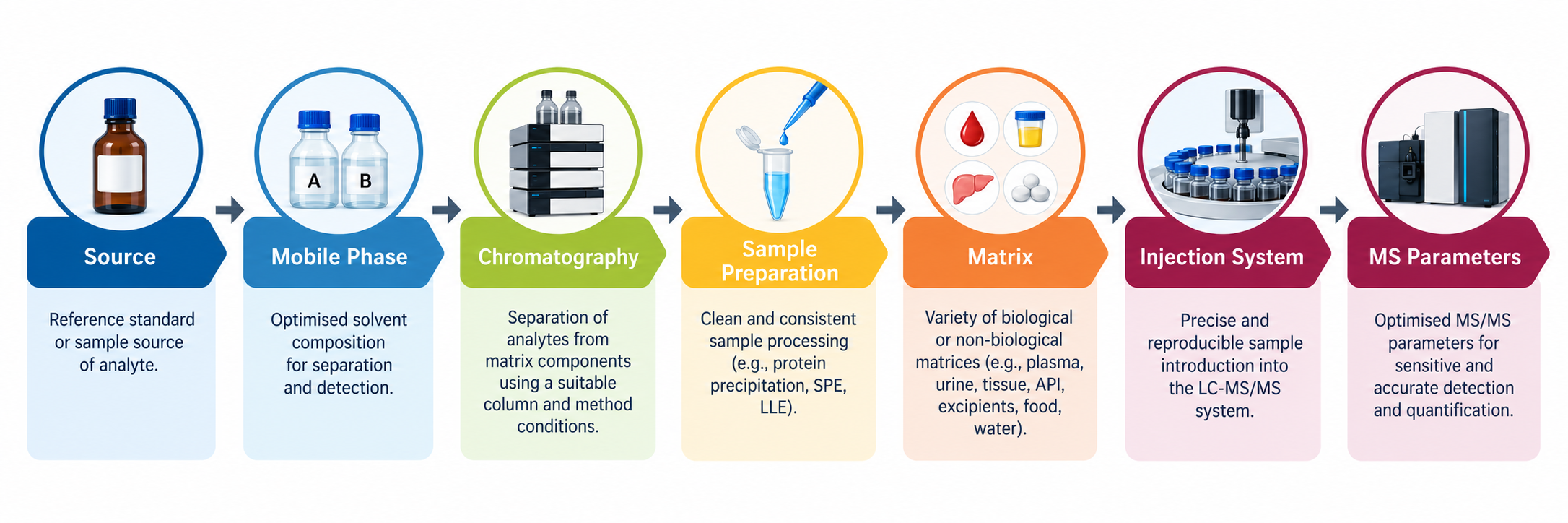
The same approach applies to retention time shifts. A change in Retention time could come from mobile phase preparation, flow, column condition, equilibration, temperature or even the
sample solvent. The priority is always to identify the root cause rather than adjusting multiple parameters at once.
Routine testing is the real test
A method can look excellent during development but routine testing is where its robustness is truly tested.
In routine use, methods must hold up across different analysts, different sample matrices, long sequences, multiple batches, column ageing, source contamination, carryover and instrument maintenance. This is why system suitability checks and ongoing routine monitoring are such a critical part of our quality process.
NDSRIs: the next level of complexity
The nitrosamine discussion has expanded to include nitrosamine drug substance related impurities (NDSRIs). These introduce additional challenges because their structures are related to the drug substance itself and its chemistry.
Depending on the compound laboratories may face added challenges around sensitivity, selectivity, chromatographic separation, matrix effects and reference standard availability. This makes method development even more dependent on understanding the chemistry of the molecule rather than relying on instrument parameters alone.
Conclusion
Reliable nitrosamine testing by LC-MS/MS goes beyond achieving a low LOQ. From method development and validation to method transfer and routine testing, every step contributes to accurate, specific and consistent results. At SCIOM, our analytical expertise and systematic approach help pharmaceutical laboratories build confidence in nitrosamine and NDSRI testing, supporting reliable pharmaceutical quality control.