
Analytical Method Development Overview
Strong methods. Reliable outcomes.
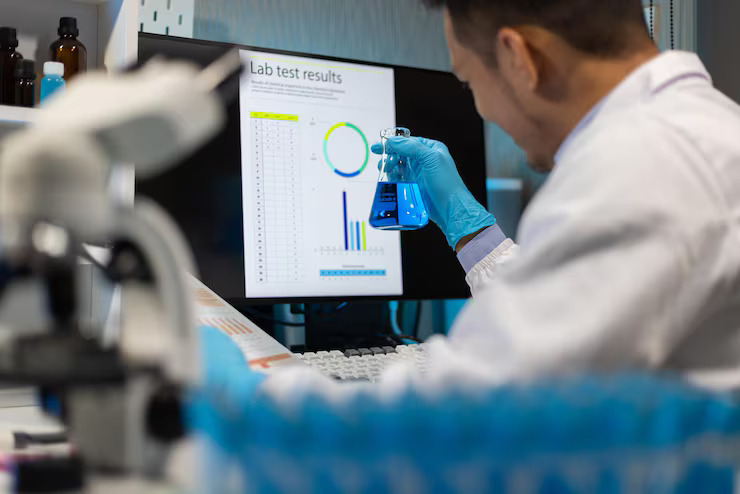
Sciom has extensive experience in developing analytical test methods for a wide range of pharmaceutical products in accordance with international regulatory requirements. We support the complete analytical method development process, from initial project planning and protocol preparation to method execution and comprehensive reporting, ensuring the methods are robust, reliable, and suitable for regulatory submission.
Discuss Your Analytical RequirementsAnalytical Method Development Lifecycle
Designed. Tested. Perfected.
Defining Objective and Scope:
Each project begins with a clear definition of the analytical objective and scope for the QC method.The team specifies what needs to be measured (assay, related substances, dissolution, content uniformity, identification), the sample matrix, and the required working range.Target performance criteria are agreed upfront, including accuracy, precision, specificity, sensitivity, robustness, and applicable regulatory or pharmacopoeial expectations.
Collecting Background and Product Knowledge:
A thorough knowledge-gathering phase follows, reviewing pharmacopoeial methods, internal or legacy procedures, and scientific literature for similar products. Physicochemical properties of the analyte and key excipients (solubility, pKa, stability, degradation pathways) are evaluated in detail. This understanding shapes the analytical strategy and highlights potential interferences early.
Selecting Technique and Initial Conditions:
Based on the defined objective and analyte characteristics, the most suitable analytical technique (HPLC/UPLC, GC, UV/Vis, FTIR, titration, etc.) is selected. These choices are translated into practical starting conditions such as column chemistry, mobile phase, detection settings, and sample preparation. From the outset, conditions are designed to be safe, cost-effective, and compatible with routine QC workflows.
Method Development and Optimization
The method is built and refined through structured scouting experiments to confirm detectability of analytes and major impurities or degradants. Critical parameters (pH, organic ratio, gradient, temperature, flow, injection volume) are systematically optimized to deliver robust separation, good peak shape, and efficient run times. Specificity, solution stability, and sample stability are evaluated under realistic laboratory conditions.
Preliminary Performance Evaluation (Pre-Validation):
A focused pre-validation step confirms that the developed method can reasonably meet full validation requirements. Preliminary linearity, precision, and sensitivity are assessed alongside chromatographic indicators such as resolution, tailing factor, and plate count. Any necessary fine-tuning is performed to balance robustness, simplicity, and throughput for routine QC use. .
Defining System Suitability and Routine Controls:
Clear system suitability criteria are established, including resolution between critical peaks, theoretical plates, tailing factor, and %RSD for replicate standards. Routine controls such as blanks, system suitability solutions, standard injection frequency, and QC check samples are defined. Sample preparation and handling procedures are crafted to be straightforward, reproducible, and compliant with safety and quality expectations
Formal Method Validation
The method undergoes full validation in line with ICH guidelines and site procedures. Refer to the Analytical Method validation page.
Aligned with Regulatory Standards
Built to meet standards. Ready to perform.
Analytical methods are designed, validated, and documented in line with current regulatory guidelines, supporting smooth regulatory submissions, inspections, and ongoing compliance.
-
Regulatory alignment with applicable guidelines
-
Quality by Design (QbD) implementation
-
Lifecycle management and continuous improvement
-
Technology transfer between R&D and quality control (QC)
-
Reduction of out-of-specification (OOS) and out-of-trend (OOT) results
-
Control of critical quality attributes (CQAs)
-
Process understanding and risk mitigation
-
Inspection readiness and audit support
-
Cost-effective and efficient QC operations

Analytical Expertise
Deep science. Real solutions.
Our method development team brings extensive experience across HPLC/UPLC, GC, LC/MS, GC/MS, dissolution, spectroscopy, and complex sample preparation to address a wide range of analytical challenges. A structured, QbD-driven approach is applied throughout, from impurity profiling and stability-indicating methods to trace-level quantification, ensuring methods remain scientifically sound, reliable, and suitable for transfer across laboratories while aligning with regulatory expectations.
Chromatography & MS Expertise
Deep experience across HPLC/UPLC, GC, LC-MS, and GC-MS for complex products, impurities, and trace-level quantification
Complex Sample Handling
Advanced sample preparation strategies for challenging matrices, degradants, and low-level analytes
QbD-Driven Method Design
Structured, QbD-based development from scouting to robust, validated, and transfer-ready methods.
QC-Ready Implementation
Methods engineered for routine QC: practical run times, clear system suitability, and inspection-ready documentation
Why Sciom for Analytical Method Development
Methods you can trust.
Sciom provides end-to-end analytical method development that is scientifically rigorous, regulatory-aligned, and genuinely QC-friendly. Methods are designed not only to pass validation, but to run reliably in real laboratories, across products, sites, and inspectors
- End-to-end method development from concept to validated, QC-ready procedure
- Expertise across HPLC/UPLC, GC, LC‑MS, GC‑MS, dissolution, and spectroscopy
- Proven stability‑indicating and impurity profiling capabilities
- QbD‑driven approach for robust, reproducible performance
- Designed for real‑world QC practicality, throughput, and ease of use
- Strong focus on reducing OOS/OOT results and repeat investigations
- Comprehensive validation packages and inspection‑ready documentation
- Seamless method transfer support between R&D, QC, and multiple sites
- Flexible collaboration models to fit your project timelines and budgets
- Experience with global regulatory expectations and current guidelines

Our Comprehensive CDMO Service
Everything you need. One trusted partner.
Insights & Industry Trends
Stay informed with expert insights on pharmaceutical product development, analytical services, formulation development, testing and CDMO solutions across the pharmaceutical industry.

31 August 2026
Pharmaceutical Product Development: A Guide to Reducing Risk at Every Stage
Explore Article

26 February 2026